
Hold Fast, Harvard
"This Is Not Calvinball and There Are Rules" - Judge Allison Burroughs

Disclaimer:
I’m a lawyer. I work at Harvard. This post is my own work, written in my personal capacity. However, I believe the Constitution applies even when the executive branch is angry, impatient, or convinced of its own righteousness. Nothing here is legal advice. If you are facing a federal investigation, funding freeze, or “historic deal,” talk to qualified counsel, not a Substack newsletter.
And if you think using civil rights law as leverage for ideological control and cash extraction is sound public policy, I regret to inform you that a federal judge has already rejected that theory on the merits, which is a polite judicial way of saying the scheme is legally indefensible nonsense.
Hold Fast, Harvard
There are two kinds of letters you expect to land “with a thud” (NYT’s word choice) in a university president’s inbox: the annual reminder about cybersecurity training, and the kind that tries to turn the federal government into a collection agency with a civil-rights logo.
Harvard got the second one.
According to The New York Times, Education Secretary Linda McMahon (known for her work with wrestling, rather than education) wrote Harvard President Alan Garber on a Saturday during winter break, thanking him for what she described as a commitment to send $200 million in cash (!) to the government as part of a broader $500 million resolution; even though Harvard’s position (per President Garber’s reply) was that the proposal was $500 million total for workforce development, not “$300 million plus $200 million cash.”
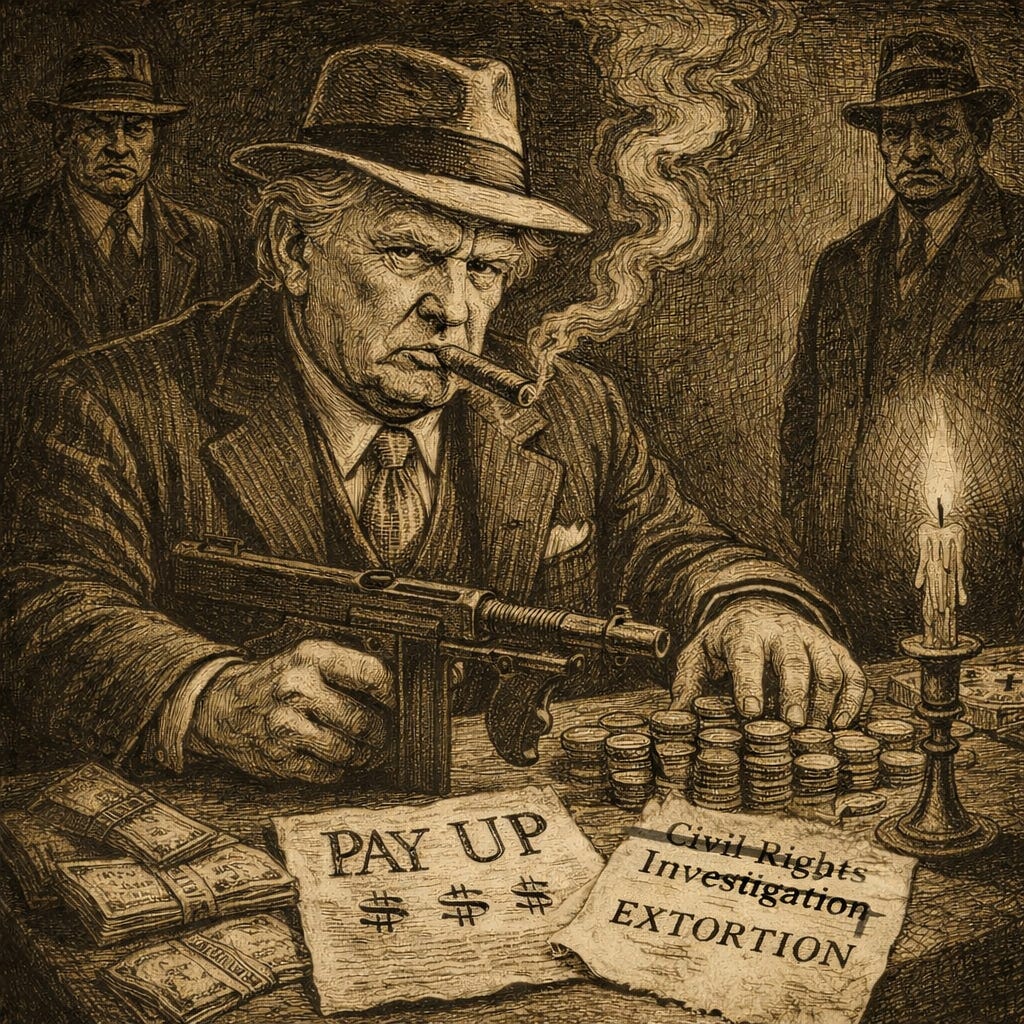
If this was a misunderstanding, it’s an astonishingly reckless one. If it wasn’t, it reads like something worse, like an extortion tactic. Either way, it’s the same message in practice: pay up, call it “civil rights,” and we’ll talk about your constitutional rights afterward.
That’s not “negotiation.” That’s a shakedown with letterhead.
The part they keep forgetting: they already lost in court
This is what makes the McMahon letter so galling: the administration’s core leverage has already been declared unlawful, in writing, at length, by a federal judge.
On September 3, 2025, Judge Allison D. Burroughs granted Harvard summary-judgment wins on the central theory that the administration froze and terminated roughly $2.2 billion in research funding as punishment for protected speech and refusal to surrender institutional autonomy.
Burroughs did not mince words. In the conclusion of her 84‑page opinion, she wrote that the record made it “difficult to conclude” anything other than that defendants used antisemitism “as a smokescreen for a targeted, ideologically-motivated assault” on premier universities, and that the campaign ran afoul of the APA, the First Amendment, and Title VI.
And when the government tried to wriggle out of the case on procedural technicalities, insisting it belonged elsewhere, Burroughs delivered a line that deserves to be printed on bumper stickers and stapled to every future “trust us” filing:
“But this is not Calvinball and there are rules.”
For those not familiar with “Calvinball” it is a game in which the child Calvin (from the Calvin and Hobbes comics) changes the rules whenever he wishes, so as to ensure his own victory. (Sound familiar?) However, the translation of this reference is clear in this case: the judge is saying you don’t get to invent new rules of federal power because you’re angry at a university.

Legally, the opinion matters in three ways that should be front-and-center in any “Mostly Lawful” take:
First Amendment retaliation: the government cannot punish protected expression (including refusing viewpoint-based demands and petitioning the courts) by stripping funds.
Title VI procedure: you don’t get to scream “civil rights!” and then ignore the statutory process civil-rights enforcement requires.
APA arbitrariness: agencies can’t do “because we said so,” especially when the administrative record doesn’t show reasoned decision-making connecting terminated grants to the stated goal.
That legal backdrop is why Harvard must treat every new “deal term” as what it is: a work-around attempt. Not a dang peace treaty.
The appeal is real, and it’s the point
The administration has appealed that ruling from September. Reuters reported that the Trump administration filed a notice of appeal to the First Circuit after Burroughs’ ruling.
But the appeal is not merely litigation posture. It’s part of the message: we will keep pulling levers until you comply. Which means the only sustainable response is not “find the least humiliating surrender.” It’s build a record, win the law, and make the next step harder, politically and legally.
That’s what “hold fast” means here: not performative defiance, but disciplined refusal to trade constitutional rights for temporary quiet.
The three faces of bad-faith governance
This is where your villains come in; not as cartoon characters, but as the administration’s enforcement trio: the ideologue, the weaponizer, and the messenger who can’t stop stepping on rakes.
Stephen Miller: the ideological bouncer
Stephen Miller is not subtle. He’s a senior Trump policy figure and a long-time immigration hardliner. And total nightmare of a human (?) lawyer. If you want to read more about Miller’s attempt to undo every democratic and legal principle on which American was founded, read the Mostly Lawful post “Unholy Counsel: Stephen Miller, the Constitution, and the Vampiric Assault on States’ Rights.”
In the Harvard talks, the Times reports that Miller “has seemed to undermine proposed agreements” with Harvard in private meetings, per two officials involved in discussions.
Color me not surprised. Stephen Miller is a nightmare of a human being. Years ago, the Southern Poverty Law Center (SPLC) published over 900 emails that Miller sent to Breitbart editors before joining the White House. These emails showcased anti-immigrant views and promoted content from white nationalist and neo-Nazi websites.
So, if you’re looking for the worldview behind the move from “compliance” to “punishment,” this is it: the goal isn’t just changes at Harvard, it’s a public example. A trophy head for the wall so other universities learn to flinch on cue.
Harmeet K. Dhillon: “civil rights” as a culture-war crowbar
Harmeet Dhillon, confirmed in 2025 to lead DOJ’s Civil Rights Division, is described by Reuters as a Trump loyalist whose leadership drew major concern from civil-rights advocates.
KQED notes she built a public profile through litigation aimed at pandemic restrictions and transgender-rights issues, and aligned herself with Trump’s election-denial ecosystem. And in the Harvard negotiations, the Times reports Dhillon has gained increased influence and argued the talks were “teeter[ing] too much in Harvard’s favor.”
This person represents the moral rot at the center of the strategy: turn civil-rights enforcement into a political cudgel, not to vindicate rights through law, but to force ideological “reforms,” scoop up cash, and demand ongoing compliance rituals.
Dhillon’s background is almost beside the point, except for one bitter irony: America is a country where immigrants (and the children of immigrants) often understand, better than anyone, what it means when the state starts treating “disfavored communities” as bargaining chips. Despite the facts that Dhillon was born in Chandigarh, India (to a Punjabi Sikh family in 1968) she has chosen to work for an administration that clearly does not respect any immigrants, or their rights in this country.
That’s why this tactic is so corrosive: it trains the public to accept the government using “rights” language while doing power politics in the back room.
Linda McMahon: the messenger of the mugging
Linda McMahon was sworn in as Secretary of Education on March 3, 2025. She is also, as nearly every profile notes, a former wrestling executive, a fact that would be merely biographical if the Harvard letter didn’t read like a contract promo cut for the WWE.
The Times describes her letter as asserting Harvard agreed to “$300 million… in addition to $200 million in cash,” and pushing urgency: “It is time to get this deal done.”
Here’s the problem: when the government’s own account of negotiations is this slippery, it reinforces the case Harvard has already been making; that this campaign is procedurally infirm and substantively coercive. The Burroughs opinion isn’t just a legal win; it’s a judicial diagnosis of a pattern. Did McMahon not read Judge Burroughs’ total evisceration of the governments arguments? By the read of her recent letter, she didn’t read it or (like most Trump lackeys) just ignored it.
Maybe Linda McMahon is so used to wrestling outcomes going in the direction she decides, that she can’t tell the difference between a courtroom and the wresting ring. The good news is that Judge Burroughs handed Trump the “piledriver” of a total legal loss.
“Deals” that aren’t deals
And we (and the press!) should stop calling these arrangements “settlements” in the ordinary sense, as if the government brought a proven claim and negotiated a remedy.
The model looks more like this:
First, freeze or threaten to freeze funding.
Open multiple investigations across agencies.
Float numbers that feel like ransoms (or “fines”).
Then, demand ongoing reporting/monitoring that functions like federal supervision of internal governance.
Lastly, announce “historic deal,” collect money, move on to the next target.
That pattern isn’t hypothetical. Columbia agreed to a $200 million “fine” along with other oversight terms, under pressure to restore funding, and AP has reported that, historically, civil-rights settlements with universities have NOT typically involved independent monitoring or monetary fines of this kind.
Cornell publicly stated it would pay $30 million to the federal government (and invest another $30 million in agriculture research) while insisting the resolution was not an admission of wrongdoing.
Northwestern’s agreement similarly involved a $75 million payment to regain access to $790 million in federal funding, Reuters reported.
Brown’s resolution, by contrast, emphasized workforce-development spending and explicitly framed itself as preserving academic independence and avoiding government intrusion.
So when Harvard refuses to call a payment a “fine,” it isn’t being cute. It’s spotting the trap: once you pay a “fine” without an adjudicated violation, you’re not just buying peace, you’re creating a precedent. And a dangerous precedent at that - the executive branch can extract cash from private institutions by threatening essential public-interest research and then calling the transfer “civil rights.”
That’s not enforcement. That’s monetization.
Why the “fine” language matters
Now zoom out to the broader fiscal landscape. In 2025, Trump signed the One Big Beautiful Bill Act, which CBO estimated would increase the primary deficit by $2.4 trillion over 2025–2034, driven by roughly $3.7 trillion in revenue reductions. So the bill cuts taxes for the wealthy, and it is projected to increase the national debt by roughly trillions. So with all these tax breaks for corporations and the uber-wealthy, how will the federal government replace this missing money to pay for services?
To offset some of these tax cuts, the bill included over $1 trillion in spending cuts to programs such as Medicaid, Medicare, and SNAP food assistance.
So, the estimates suggest the bill provides approximately $4.5 trillion in tax breaks, with a significant portion benefiting the top 10% of earners.
Separate distributional analyses have found that the benefits of the tax/tariff package skew upward, benefiting the top 10% of earners, while most income groups do worse on average.
I’m not claiming there’s a secret memo that says, “Let’s squeeze Harvard and Higher Education to balance the books.” But once you normalize giant revenue reductions and then turn around and run government like a ticket booth, fines here, tariffs there, “settlement fees” everywhere, you get something that feels less like public administration and more like a roaming protection racket wearing a flag pin.
The reason to say this out loud is simple: it clarifies motive without needing mind-reading. Even if the driving force is ideology, the mechanism is financial extraction, and the extraction is dressed up as morality.
Weaponizing civil rights, immigration, and tax status
The Harvard pressure campaign has not been confined to one lawsuit or one agency.
International students / visas: Reuters reported Burroughs (same judge) blocked the administration’s attempt to revoke Harvard’s ability to enroll international students, viewing it as part of a broader retaliatory attack.
Tax-exempt status threats: Trump publicly threatened to revoke Harvard’s tax-exempt status (see the Mostly Lawful piece below) a move experts described as legally dubious given legal constraints on presidential interference with IRS processes.
Endowment tax pressure: Reporting and policy analysis around the 2025 tax law show intensified focus on taxing large university endowments, including proposals and changes that dramatically increased rates for the wealthiest institutions.
Put those together and you see the architecture: civil rights investigations + immigration levers + tax levers + procurement threats. The point isn’t simply to correct discrete legal violations. The point is to create an environment where a university concludes it is “untenable” to keep saying no.
That is why Harvard cannot afford the luxury of “getting back to normal.” Normal is the hostage situation.
The core legal principle: the Constitution is not a vending machine
A line that will run through the whole post, “Mostly Lawful” style, is simple
The federal government does not get to condition public benefits on ideological surrender.
That’s the unconstitutional-conditions problem Judge Burroughs flagged explicitly: if the state says, “Nice research enterprise you’ve got there. Be a shame if something happened to it unless you restructure admissions, hiring, and viewpoint governance to our liking,” that is not normal bargaining.
And if the government wants to enforce Title VI, it must do it the lawful way, not by using “antisemitism” as a rhetorical accelerant while skipping the procedural requirements Congress set.
What all higher education should do now
Do not pay a “fine.” Not because Harvard is perfect, but because paying cash to the government to stop a coercive campaign is functionally a bribe demanded at scale. It invites repetition.
Keep the case in court and keep building the record. Judge Burroughs’ injunction language is not a vibes statement; it’s a legal hook for enforcing limits on future retaliation.
Treat every “new term” as a constitutional question. If it smells like viewpoint control, governance control, or compelled certification/monitoring that functionally deputizes a university against itself, it’s not a compromise, it’s a lever.
Say the quiet part out loud: This is about power, not protection. Judge Burroughs already wrote what everyone can see. Harvard and every other higher education institution that has been threated with “investigation” should quote her, early and often.
Because if Harvard backs down, the lesson to every other institution is not “comply with civil rights.” It’s “pay when the government threatens you, even if a judge says the threat is unlawful.”
And that is the precise mechanism by which democracies corrode: not in one dramatic coup, but in a thousand smaller moments where institutions decide it’s easier to write the check than defend the rule of law.
So: hold fast, Harvard. Not because you’re the good guys in every story (ask Yale!). But hold fast because this particular fight is a live-fire test of whether constitutional limits still bind the executive branch when it’s acting like a toddler who is angry.